Investment Assessment Platform
Client: Federal Tourism Agency
Role: Design and Solution Delivery Lead
Collaborators: UX/UI Designers, Project Manager and Program Manager, Product Owners, Executive Stakeholders, Marketing Agency, Solution Developer, Data Engineers, Data Scientist and Economist
Objective
A Federal tourism agency needed to move beyond a low-adoption MVP and build a reliable tool for investment decision-making — one that could turn complex spend and segmentation data into something users could actually act on. I led the full redesign, taking it from a usability problem to a trusted strategic product.
The Design Solution and the Value Created
I led a cross-disciplinary team team, including Economists, Data Scientists, and Cloud Engineers to ensure a user-centric outcome within a constrained Agile delivery timeline.
Persona-Led Feature Prioritization: To mitigate "insight overload," we shifted from "cover-all" features to a persona-led strategy (Investors and Destination Stewards). We synthesized interview insights to establish core product objectives, which directly guided the data modelling requirements.
Narrative-Driven Information Architecture: We mapped the data and insights narrative flow, creating a blueprint for a GIS-powered segmentation platform. This ensured that geospatial analytics were intuitive and adhered to the initiative’s brand guidelines.
Stakeholder Alignment: We maintained a regular cadence with the Steering Committee to keep the product aligned with business priorities. By participating in PI planning and backlog management, we built a roadmap for future scaling — including the later integration of automated ML models.
Outcome
The second release drove a measurable increase in user adoption. By giving users intuitive access to geospatial analytics and near real-time insights, the platform shifted decision-making from gut feel to data — enabling more targeted investment and resource planning.
Final product after iterative design cycles. Based on user feedback from the initial launch, my team added features including a dedicated print function in the second release.

Informed by direct user interviews and market analysis, I prioritized the feature set around actual user needs, not assumed ones.
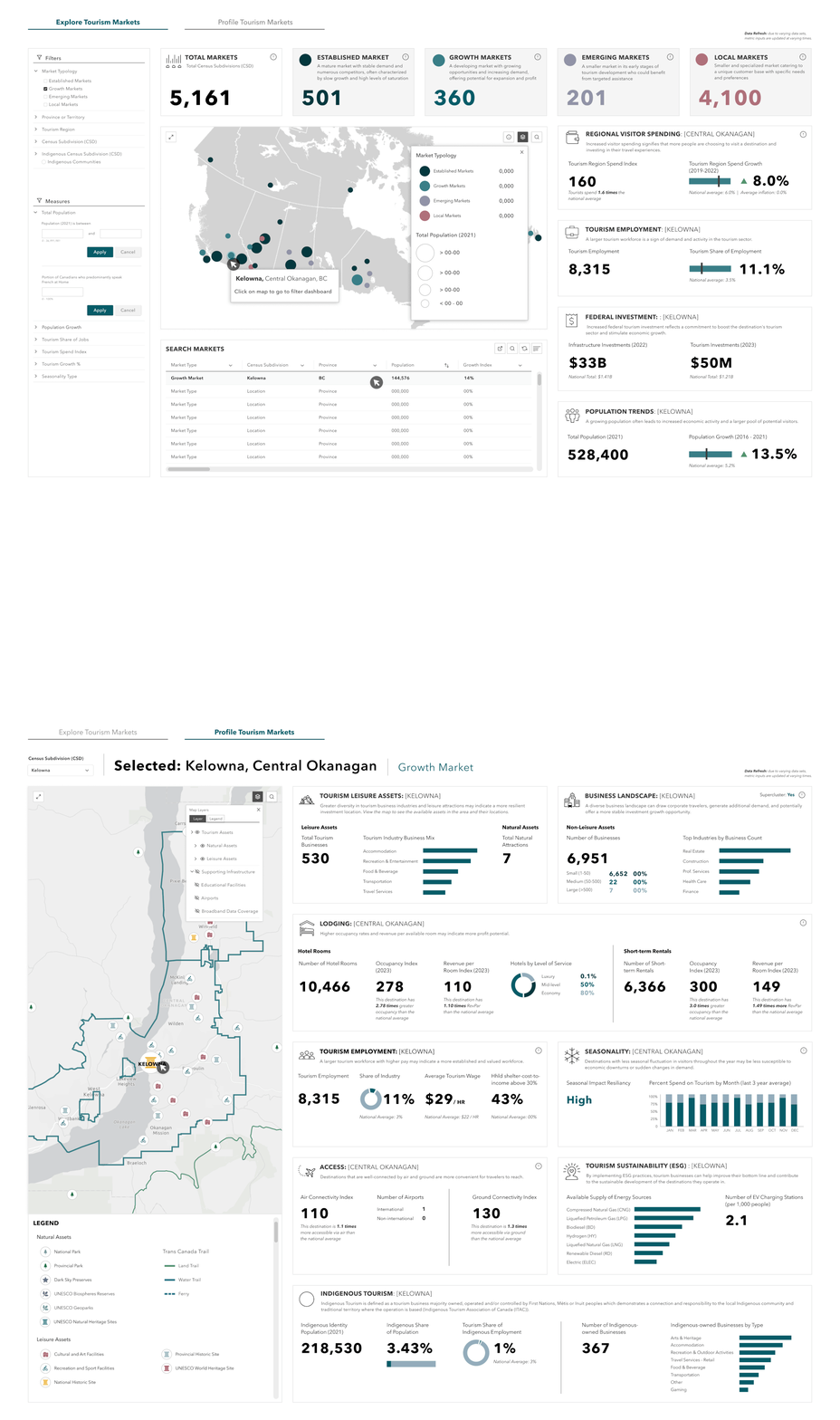
My team developed wireframes in alignment with the initiative's brand guidelines — establishing a cohesive visual language across the full product.
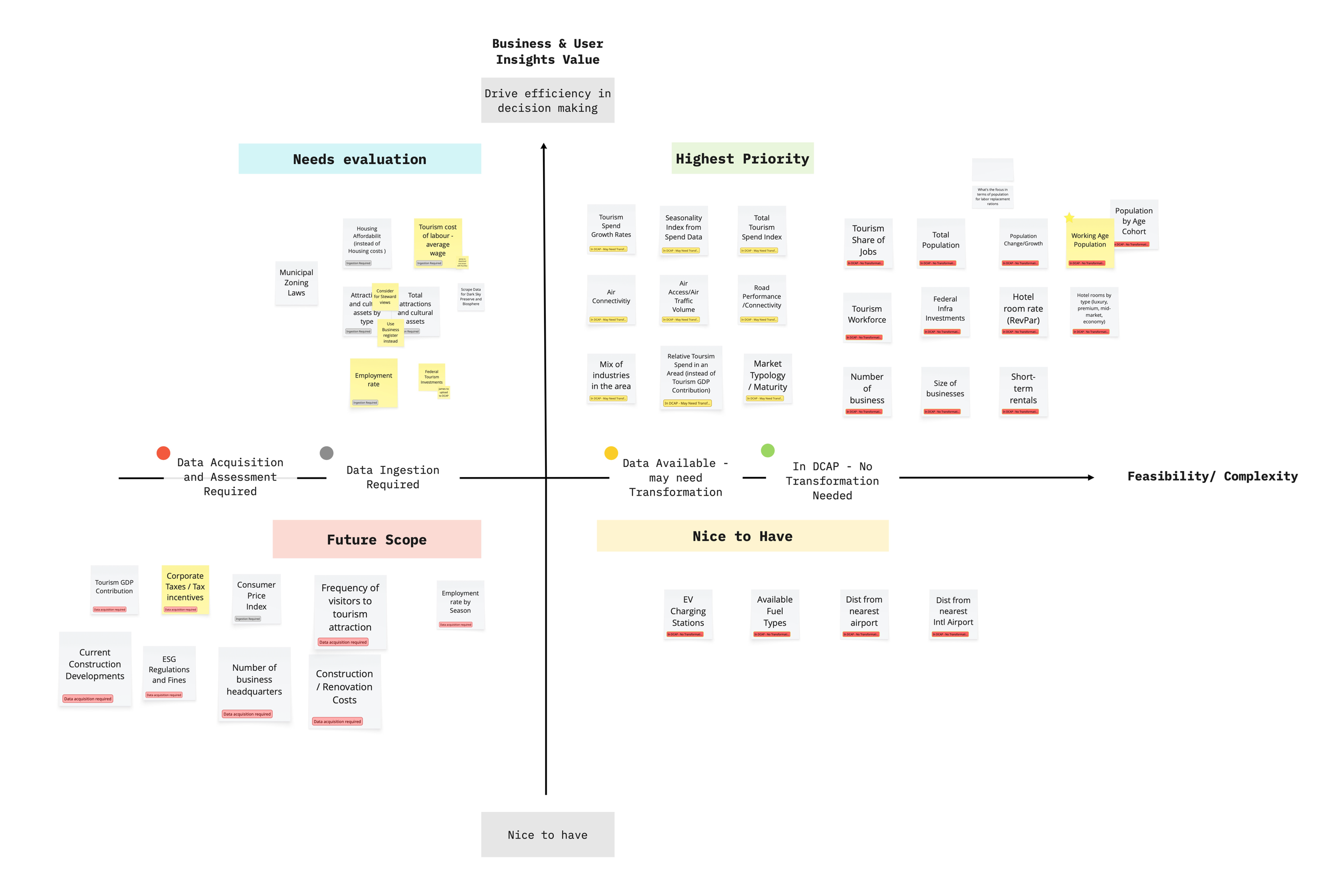
Working against a strict release deadline, I led a prioritization mapping session for MVP 2, focusing the team's effort on the highest-value items for users and the business.